
Our paper ‘The Style of Thinking: Linguistic Fingerprints of Reasoning Traces’ (with Cristiano Ciaccio, Felice Dell’Orletta and Giulia Venturi) has been accepted at Findings of EACL 2027!
Reasoning models generate extended chains of thought before producing a final answer, yet little is known about how linguistic characteristics model their style of thinking. In this paper, we introduce a fully data-driven framework that treats reasoning traces as linguistic productions and reconstructs their linguistic fingerprints from two complementary perspectives: i) a profile of 124 morpho-syntactic and syntactic features, extracted with Profiling-UD from the automatically parsed traces, and ii) the distribution of word n-grams occurring in the traces. We apply the framework to the reasoning traces produced by seven open-weight thinking LLMs from three model families (Qwen3 from 1.7B to 32B, OLMo-3-7B-Think and GLM-Z1-9B) on four reasoning benchmarks (GPQA, MuSR, StrategyQA and BIG-Bench Hard), and use these fingerprints to: i) characterize the reasoning style of each model independently of the outcome, and ii) compare successful and unsuccessful traces, both on the full trace and along the reasoning process.
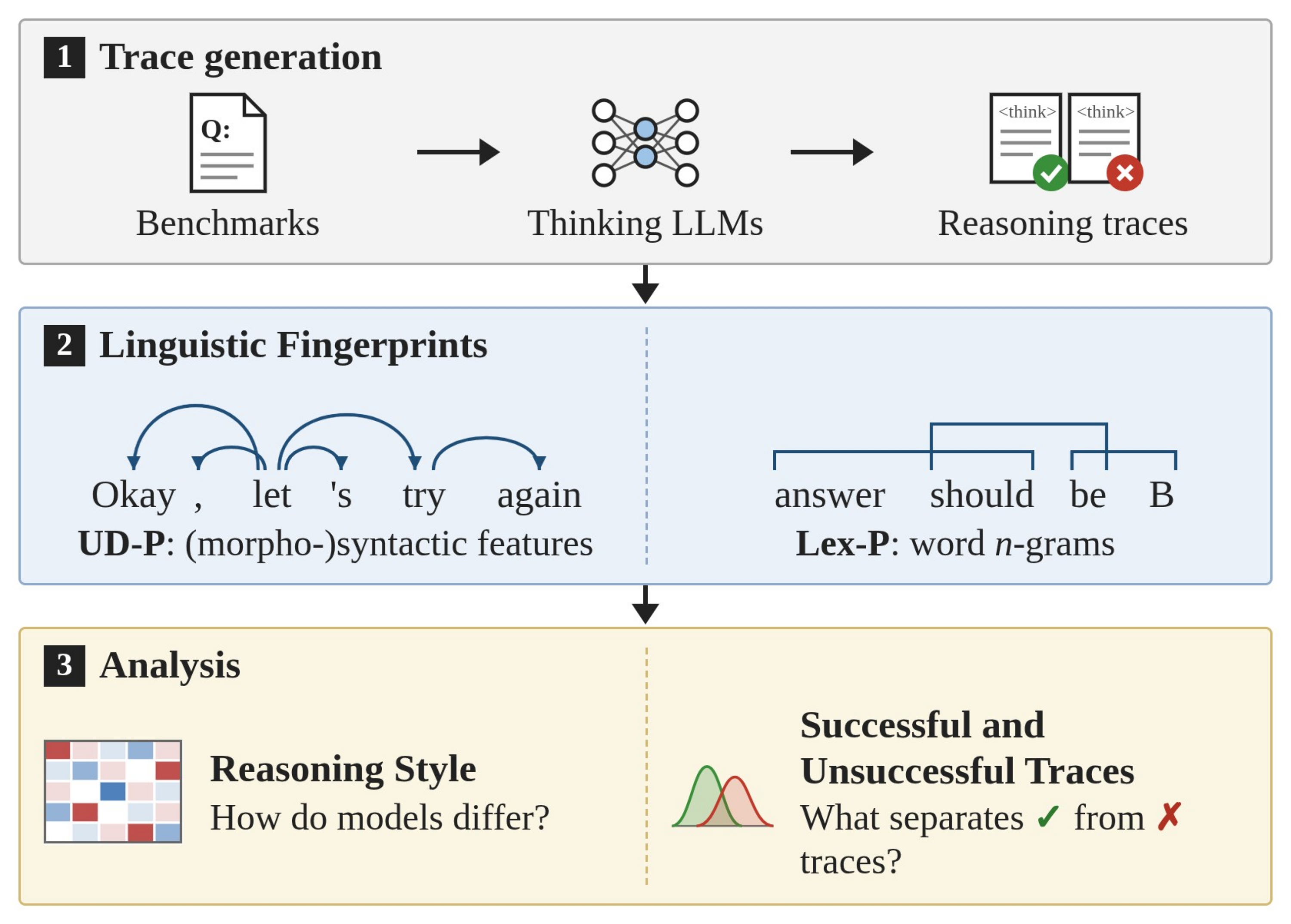
Our main findings:
- Models have distinct reasoning styles. Each model shows a recognizable linguistic fingerprint across benchmarks. Within the Qwen3 family, these styles become less distinctive as model size increases, and linguistic distinctiveness is negatively associated with accuracy across model–benchmark pairs.
- Successful and unsuccessful traces differ linguistically. Successful traces tend to be shorter and show a more direct discourse organization, while unsuccessful traces more often contain alternative reasoning paths and expressions of uncertainty (e.g., wait, but, alternatively). Many of these markers are shared across models and benchmarks.
- The boundaries of reasoning matter most. These differences are strongest at the beginning and at the end of the reasoning process, suggesting that the linguistic framing of a problem and the formulation of its final answer are particularly informative about reasoning success.
More info and the camera-ready version coming soon!